This is How to Japanese, a monthly newsletter with something about Japan/Japanese and a dash of いろいろ.
日本・日本語:I'd appreciate it
As noted in last month’s newsletter, newsletters in even months will be shorter going forward.
I thought I’d start by looking exactly nine years in the past at my blog How to Japanese (exactly half of its lifetime), and in doing so I found this gem of a post on Yahoo Chiebukuro, from which I am currently banned for some reason. My Yahoo email address seems to have expired and my phone number is also flagged and unable to register a new account. I don’t remember doing anything that would’ve resulted in this. Alas.
While I can’t post any questions of my own, I can still read everything they’ve got, including all of the links I shared on that blog post.
I was also reminded of this post, which I’d completely forgotten. I badly needed a reminder about this beautiful definition of 幸い (saiwai) when used as a request:
文字通り、そうしていただければ幸せだということです。
そこには、望ましい、ありがたい、都合がいい、などの意味が含まれています。日本語の美しさのひとつです。
It literally means, “If you could do that for me, I would be happy.” It also has the implication of “desirable,” “grateful,” and “convenient” included. This is one of the ways in which Japanese is beautiful.
I love it. Japanese is indeed beautiful, and the flexible phrase the poster is talking about is one of the most frequent I use at work. As I noted in my blog post, it’s generally in one of the combinations below:
~ていただければ幸いです (~te itadakereba saiwai desu)
~ていただけたら幸いです (~te itadaketara saiwai desu)
~ていただけますと幸いです (~te itadakemasu to saiwai desu)
These are all slightly different ways to say “I’d appreciate it if you could/would ~.”
This structure is also extremely flexible. You can also swap out other adjectives/verbs for 幸い to create different nuances:
~ていただければ助かります (~te itadakereba tasukarimasu)
It would be helpful if you could ~
~ていただければありがたいです (~te itadakereba arigatai desu)
I’d be grateful if you could ~
~ていただければ嬉しいです (~te itadakereba ureshī desu)
I’d be pleased if you could ~
And to prove that this is living, breathing Japanese that actually gets used out in the real world, all we have to do is look at the recent incident with Yomiuri Giants manager Abe Shinnosuke who was involved in a bizarre domestic incident involving potential child abuse and ChatGPT. There was a massive media kerfuffle, and I’m going to hope that it was all a big misunderstanding. At any rate, Abe used the following phrase in his press conference, asking the media to take care when reporting on his daughter:
温かく見守って頂ければ幸いです (Atatakaku mimamotte itadakereba saiwai desu)
I would appreciate it if you’d protect her warmly.
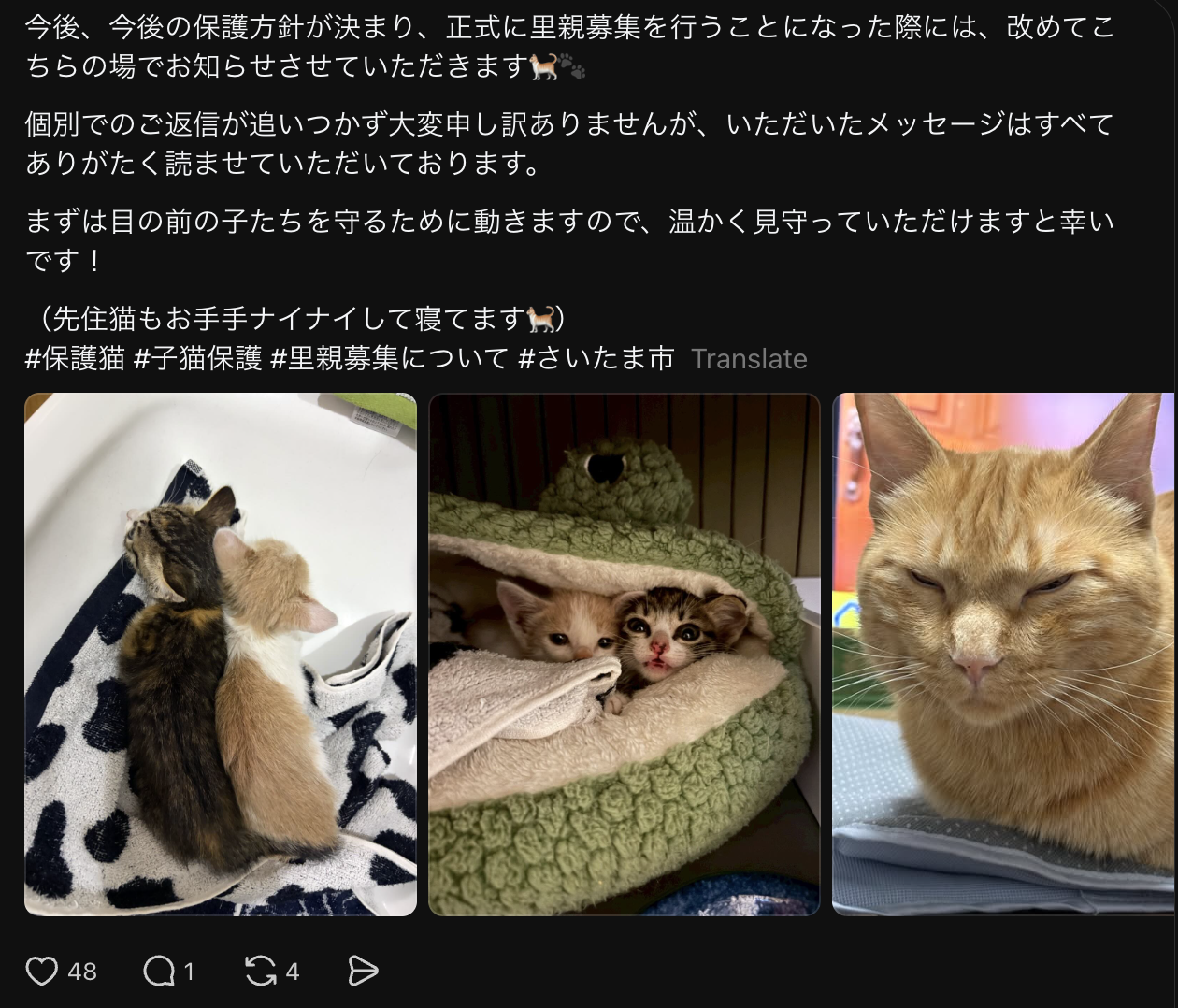
I thought this was a unique phrasing, but then I saw this post on Threads about kittens that will be up for adoption with a very similar wording:
So the embattled coach was likely drawing from the pool of collective language that we all swim in, even if it was from the deep end. At the time of writing, a Google search for the phrase in quotes turns up 48,000 hits, and the results are not dominated by this news story, so it seems like a familiar but not too common phrase.
いろいろ:
- On the blog, I wrote about another set phrase that features 幸い. I won’t spoil it here, so go take a look. I will note that on the podcast I added some additional thoughts about the patterns above, including one key idea that I forgot to write about and decided to leave out intentionally as a podcast exclusively, and also because I may use the idea in a future even-numbered month.
- It’s rainy season in Japan. In the Kinki region, it started on June 4, two days earlier than the average year but 18 days later than last year. The Japan Meteorological Agency has detailed reporting here and a FAQ that are both interesting reading.
- RIP to Sonny Rollins, the last remaining jazz musician from the truly incredible photograph "A Great Day in Harlem." Thelonious Monk, as you'd expect, is the coolest dude there.
- A colleague shared this incredible blog post on justified text in Arabic. The takeaway: “An Arabic font is a small program.” Even if you don’t read the whole thing, click through to check out the interactive sections. I also love that the post is on a blog like those that existed in the early 2000s when I first fell in love with writing on the internet.
- I have to thank Michael Camilleri for pointing out that you can link an Amazon Prime NBA League pass with the official NBA app and then watch games through it rather than through the Prime app. The official app is (excuse the pun) leagues better than Prime and includes features like an “All Possessions” replay with the excess cut, making games a digestible 40-45 minutes long. I’m surprisingly at peace with the Spurs’ loss in the Finals. I happened to be in Tokushima when they won in 2003 and behind Enryakuji in Kamakura when they won in 2007, so they’ve always been connected to my experience here. I’m tempted to spend the 19,000 yen it would cost for the entire next season. All things considered, it’s a great deal, even if it is pricey. I have until September to decide.

Member discussion: